
Florence Resident Lookup Records
No single Florence roll proves where a person lives now. A Pinal County parcel result identifies an owner and separates the property address from the tax mailing address. A recorded deed identifies parties, roles, dates, and the land involved. Court, vital, license, corporation, and unclaimed-property records answer different questions. The first task is to choose the record that can test the fact already known.
| Record | What It Confirms | Where | Access |
|---|---|---|---|
| Parcel roll | Owner, parcel situs, tax mailing address | Pinal Assessor or Treasurer | Free web search and counter |
| Recorded instruments | Named parties, document type, date, legal description | Pinal Recorder Acclaim | Index online from May 23, 1980; earlier books at office |
| Court index | Case, parties, charges, events, and outcome data | Arizona Public Access and eAccess | Free discovery; document charges or clerk request may apply |
| Vital record | Registered birth or death facts | ADHS or Pinal public health | Eligibility and proof required for recent certificates |
| Entity or license | Public business role or credential | ACC or issuing board | Free official search; address may not be a home |
| Probate filing | Decedent, fiduciary, and named heirs in public papers | Pinal Superior Court Clerk | Direct clerk request because probate is excluded online |
The voter portal is different. It verifies a registrant's own status and districts after personal inputs. It is not a public resident lookup by street. Arizona law also limits voter-data purposes and bars unauthorized online redistribution. That makes it a personal check, not a general name finder.
Verify One Florence Resident
Anchor the search to the strongest fact available. The Pinal Assessor accepts an owner name in “LAST FIRST NAME” form. Compare the parcel's property location with the tax mailing address, because they may differ. Then carry the owner name, parcel number, or legal description to the Recorder. Its disclaimer tells searchers to try spelling variants. A current parcel and a recent acquisition deed can support ownership, but neither shows every person in the household.
- Write down the full name plus one firm identifier, such as a Florence address, parcel number, entity, or case number.
- Search the Pinal County Assessor Parcel Search and separate the situs, meaning the property location, from the tax mailing address.
- Check the Pinal Recorded Document Search with spelling variants. Match the parties and legal description, not the name alone.
- Use a narrow court, entity, or license search for a second tie. Compare dates, party roles, court, and record type.
- Request the actual public file from its custodian when an index is unclear or lacks the needed field.
- Docket
- The court's chronological list of filings and events in a case.
- Index
- A finding aid with record details. It is not always the underlying document image.
- Certified copy
- An official copy authenticated by the custodian for formal use.
A commercial compilation may merge two people with the same name or keep an old address after the source changed. Official indexes have limits too, but they identify the custodian and the record being tested. That clear chain makes corrections and follow-up possible.
Florence Court Lookup Clues
The Arizona Public Access to Court Information begins with a CAPTCHA and then supports case-number and party-name discovery. Its results may include basic case data, parties, charges, docket events, outcomes, and payment history. A strong match uses the case number, court, filing date, case type, and party role together. Two identical names in separate dockets should never be treated as one Florence resident.
Superior Court documents generally enter Arizona eAccess from July 1, 2010 forward. The search can return Case, Party, Charge, Event, and Hearing information. Sealed or restricted documents do not appear, and an account or payment may be needed to obtain a document. The official eAccess screen below shows the proper state channel for going beyond a bare court index.
Open the Arizona Superior Court eAccess source before reviewing the captured portal view.
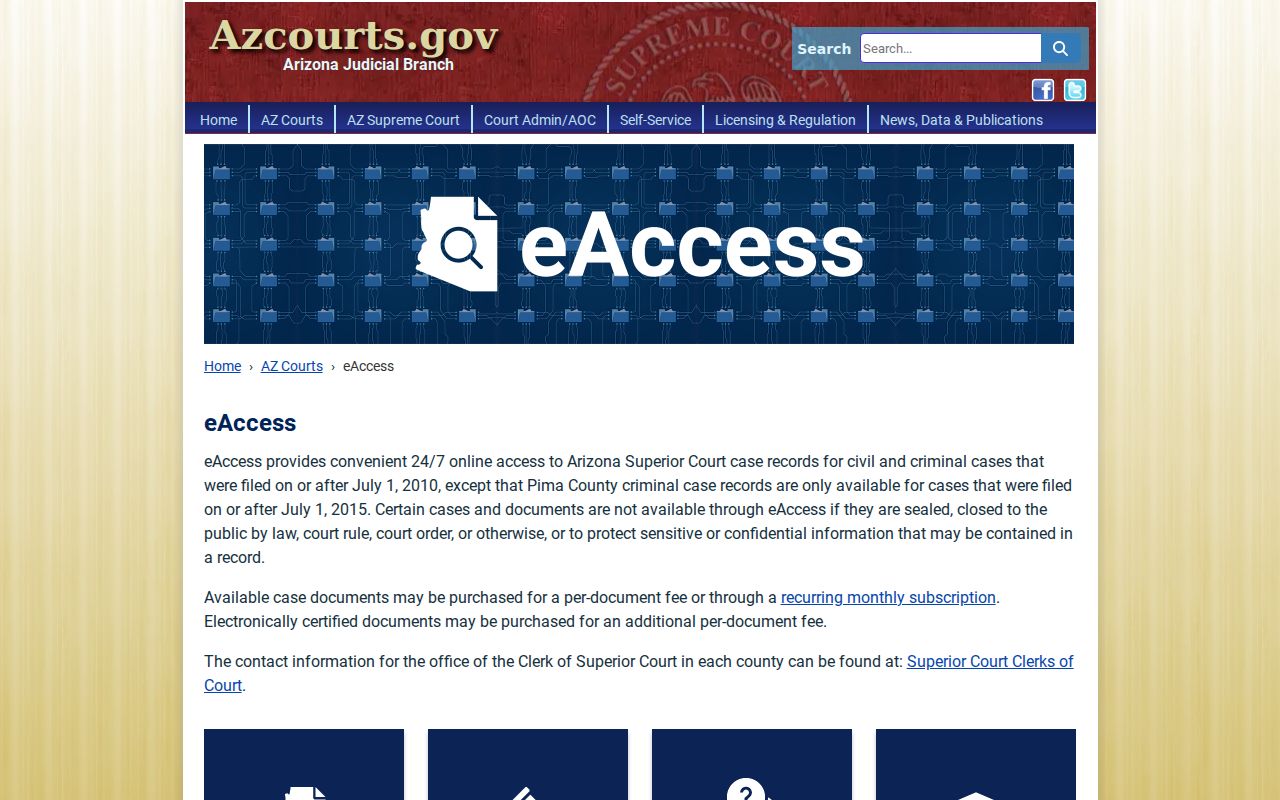
The portal view reinforces a key point: court discovery and access to an official file are separate steps.
When Florence Court Search Fails
A missing result is not proof that no case exists. Arizona's statewide display covers participating courts and excludes sealed cases, protection orders, mental-health matters, probate cases, victim and witness data, specified juvenile matters, and some local charges. Updates also trail the courts' own files. This is the resident lookup myth worth resisting: silence in a web index only means the selected portal returned nothing within its published scope.
For probate, marriage licenses, guardianship, older files, or an official copy, use the Pinal County records request channels. The Clerk of the Superior Court holds marriage licenses from 1875 forward and takes requests by case category. Supply a case identifier when possible. Without enough data, a per-year search charge may be added under Arizona law. The clerk contacts the requester about cost before processing and delivery.
Florence Municipal Court handles town misdemeanors, civil traffic matters, and ordinance cases. Its counter at Town Hall and the named court clerk remain the fallback when statewide discovery does not settle the question. A telephone call may confirm access steps, but it should not be treated as open-ended personal research.
Note: A court index is informational; a clerk-certified file is the source to rely on when the exact disposition matters.
Florence Resident Vital Records
Arizona vital records are not an open current-resident index. The Bureau of Vital Records and authorized local registrars issue recent birth and death certificates only to eligible applicants who provide identity and relationship evidence. The current Arizona death-certificate application lists the identity, relationship, signature, fee, and mail requirements. Pinal County public health is a local certificate channel. Marriage licenses belong to the Pinal Clerk, while divorce decrees are Superior Court records, not ADHS certificates.
Historical records follow another path. Birth images become public after 75 years and death images after 50 years under A.R.S. §36-351. The official genealogy portal describes births from 1855 through 1945 and deaths from 1870 through 1970. Those images can help confirm parents, occupations, residences, or informants. They are noncertified research copies.
Visit the Arizona Genealogy Record Search to see the historical birth and death search used for a Florence resident lookup.
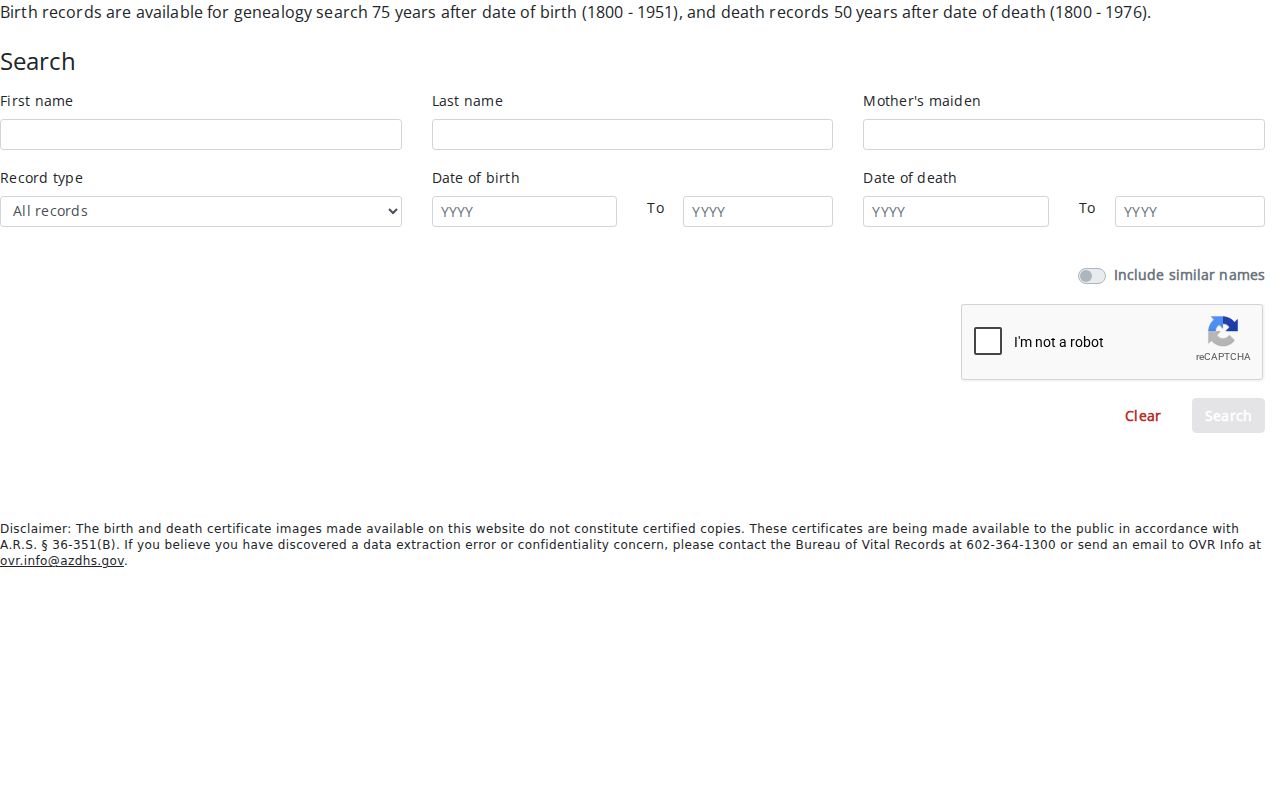
The captured search illustrates why historical images and modern certified-copy requests must not be confused.
Florence Business License Clues
A public business or credential record can corroborate an affiliation when a name is common. The Arizona Corporation Commission eCorp search accepts an entity name, statutory agent, principal, or entity ID as its main criterion. Filters include entity type, status, name type, and county. Filing dates, roles, and document history help distinguish people. A statutory agent's address is for legal service and may not be a residence.
Board records have the same narrow value. Arizona Care Check covers public health-care license information, while other professions route through their own state boards. A license result can confirm a name, credential, status, and sometimes a public address or discipline. Confidential complaints and investigations may remain closed.
Open Arizona Care Check before viewing the official license-search capture.
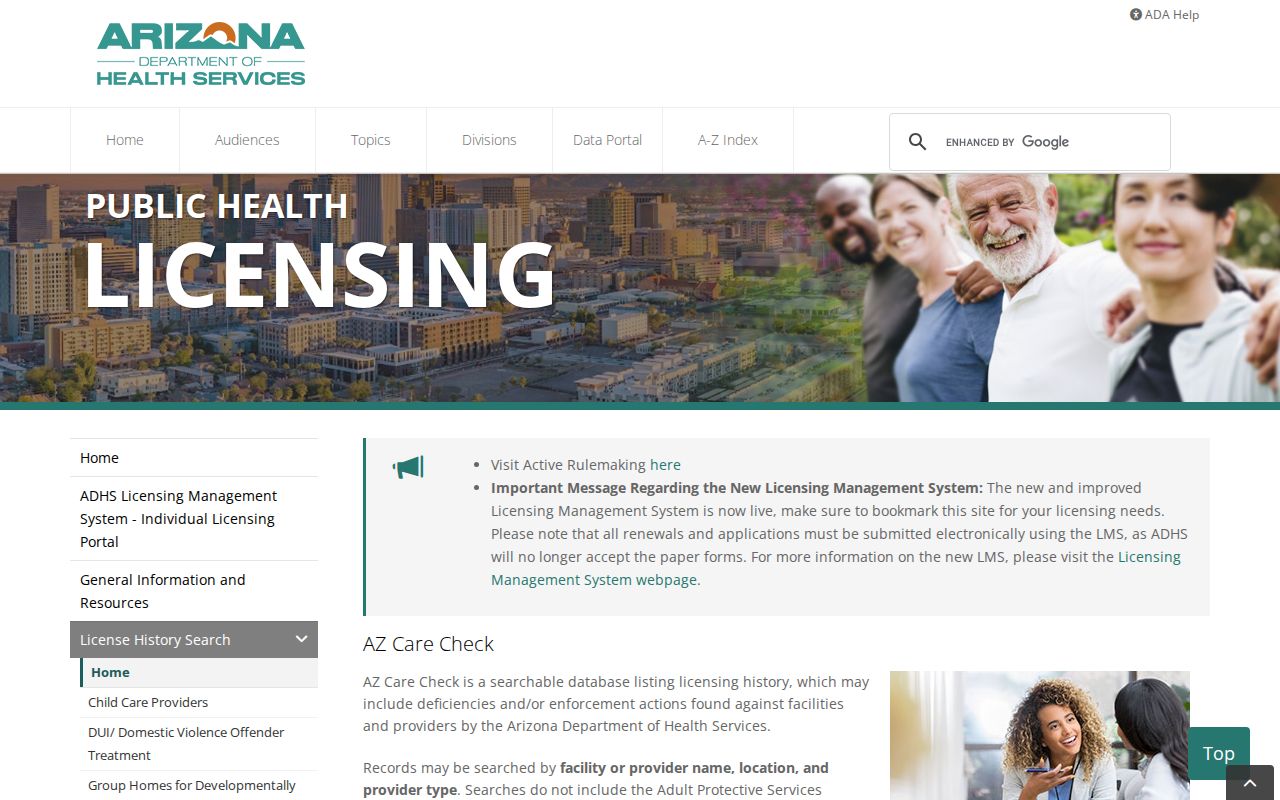
The screen is useful for credential verification, but it should be paired with a Florence-specific fact before two names are linked.
Another weak but useful clue comes from the Arizona Department of Revenue unclaimed-property search. It is free and may tie a name to a holder-reported last-known place. It does not prove a current address.
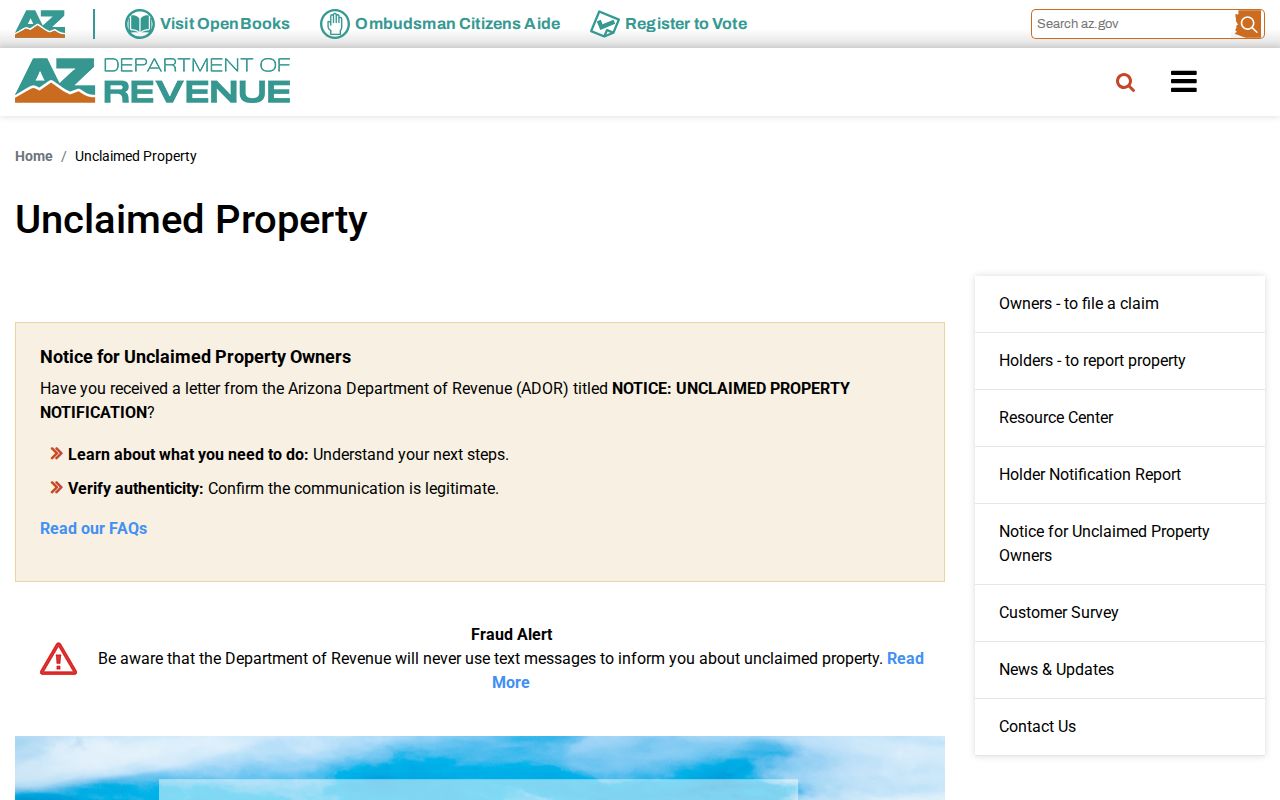
The official capture shows a lawful last-known-place lead that still needs support from a stronger record.
Consent-Based Florence Family Search
Birth-family research has a lawful route that does not defeat sealed records. Arizona's Confidential Intermediary Program permits trained court-appointed intermediaries to use otherwise confidential sources for adoption-triad searches under A.R.S. §8-134. Identifying or nonidentifying information is exchanged only under the program's consent rules. A related sibling program operates under §8-543.
That process differs from an ordinary Florence resident lookup. The intermediary, not the searcher, accesses protected sources and seeks consent. It is designed for adopted people, birth parents, adoptive parents, siblings, and other eligible participants described by the program. This human-use channel matters because a protected record is not a dead end that justifies guessing.
Read the Arizona Confidential Intermediary Program requirements before viewing its official program page.
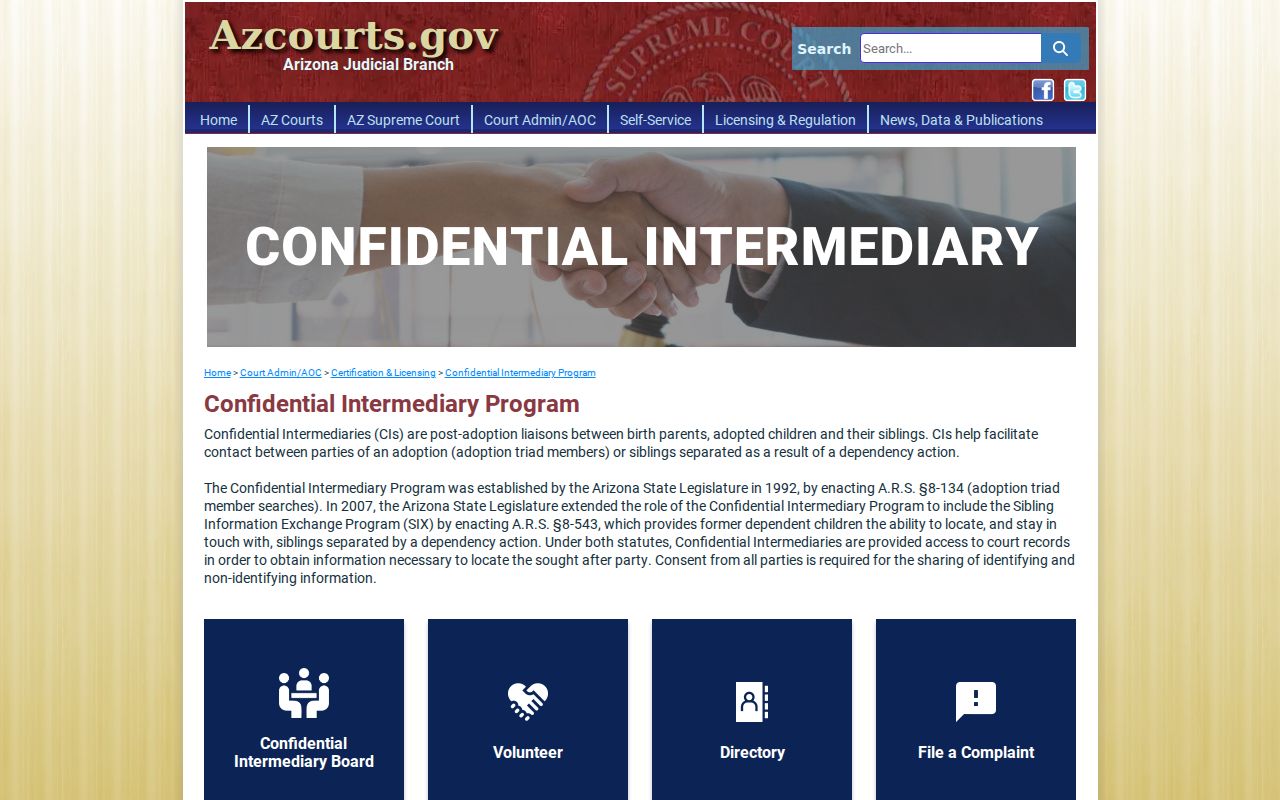
The program capture points to a consent-based court process, not a public name database.
Florence Resident Lookup Limits
Some Florence residents are absent for sound legal reasons. The Arizona Address Confidentiality Program provides qualifying victims with a substitute address and mail forwarding. Protected voters may have registration records sealed under A.R.S. §16-153. Recent vital records, adoption files, juvenile information, victim locations, and sealed court documents also have specific access bars. An omission should not be filled with an unsupported inference.
When a public field should exist but is not online, send a precise request under the Arizona Public Records Law. Name the custodian, record type, approximate date, and known identifier. The Town Clerk handles Florence municipal records and the county request hub separates departmental, Sheriff, and court channels. Inspection must be available during office hours, subject to lawful redaction. A focused request is more likely to find the record than a demand for everything about a person.
Lawful use. A Florence resident lookup is for personal and lawful research. Never use an address, court clue, or family fact to stalk, harass, threaten, or cause unwanted contact.
Errors belong with the source custodian. Save the case number, parcel, document fee number, or license ID, then ask the responsible office about correction or clarification. A screenshot from a secondary source cannot amend an official index.