
Florence Neighbors Record Sources
A block search asks a smaller question than a full street directory. Start at one Florence parcel and inspect the lots that touch it or face it. The official sources identify land, named owners, tax-mail destinations, mapped local cases, and public business contacts. They do not supply a verified list of every adult, renter, guest, or child at an address. That line is essential when learning about Florence neighbors.
| Source | What It Shows About a Block | Access |
|---|---|---|
| Pinal Parcel Viewer | Target and adjacent parcel geometry with owner-linked records | Free interactive viewer; click each parcel |
| Assessor parcel roll | Owner, property location, parcel number, legal and zoning context | Free owner, address, parcel, subdivision, or legal-location search |
| Treasurer tax search | Owner tax-mail address, account, bills, and payment data | Free web search; inquiry updates nightly |
| Florence town files | Permit applicant, licensed business, mapped code issue, or council record | Portal, written request, or Town Clerk counter |
| Voter information | A person's own registration and district details | Personal portal; public data uses limited by state law |
| Community groups | Association or watch contact, when voluntarily published | Public contact pages; no verified public household rosters |
An owner name is a land record, not a household inventory. A tax-mailing address may point to another city or to a business office. Even when tax mail and the parcel situs match, occupancy remains an inference unless another lawful source confirms it.
Map Florence Neighbors Parcel by Parcel
The Pinal County Assessor Parcel Viewer supports the practical block method. Search or zoom to the target address or assessor parcel number, often called an APN. Click its polygon, then click each touching lot and each lot across the road separately. No automated area capability is assumed, so a careful parcel-by-parcel walk is the accurate method.
- Find the known Florence address or APN and confirm the target parcel's shape and location.
- Open each adjacent parcel one at a time. Record the APN and owner-linked result without assuming the owner lives there.
- Search each APN in the Pinal Assessor Parcel Search. Compare the property location with the tax mailing address.
- Check the parcel in the Treasurer inquiry when payment or tax-mail context matters. Its data updates nightly.
- Use town permit or mapped code records only as address context. An applicant or complainant may not be an occupant.
The county map also offers zoning, flood, comprehensive-plan, school, district, and other civic layers. Those boundaries are informative and are not legal descriptions. For a whole named road rather than the immediate block, the Florence street directory carries the longer address chain.
Florence Block Ownership Clues
Parcel records work best when their fields stay distinct. A situs address is the physical location assigned to the property. The tax-mailing address is where the Treasurer or Assessor sends notices. A legal description identifies the land through recorded terms rather than a mailing label. One Florence owner may hold several nearby parcels, while another parcel may be owned by a trust or entity.
- APN
- The assessor parcel number used to connect the map, property roll, tax inquiry, and legal data.
- Situs
- The listed physical property location, which may differ from the owner's mailing address.
- Adjacent parcel
- A separately indexed lot that touches the target parcel boundary.
- Legal description
- The recorded land description used to distinguish property when an address is not enough.
If ownership history matters, bridge from the APN or legal description to the Recorder's Acclaim index. It accepts party name, fee number, document type, date, legal description, and docket or page searches. The online range begins May 23, 1980. This supports the land trail, but it still does not turn the deed chain into a list of current Florence neighbors.
Note: Across-the-street parcels do not touch the target polygon, so they must be selected and checked as separate records.
Florence Voter Data Is Different
The Arizona Voter Information Portal checks a registrant's own status, districts, notices, ballot-by-mail status, and voting history after personal inputs. Address mode finds polling information, not names at an address. Voting history means participation, never the selections made on a ballot. Treat the portal as a personal service rather than a block directory.
Public voter data is controlled by A.R.S. §16-168. Allowed uses center on political, campaign, election, district-boundary, or specifically authorized purposes. Commercial requests and unauthorized internet redistribution are barred. The Arizona Attorney General voter-data opinion inventories the database fields and release limits. Public inspection omits sensitive fields, including month and day of birth, Social Security and state ID numbers, signatures, email, and several identity questions.
Read the official Arizona voter-record access limits before viewing the captured statute page.
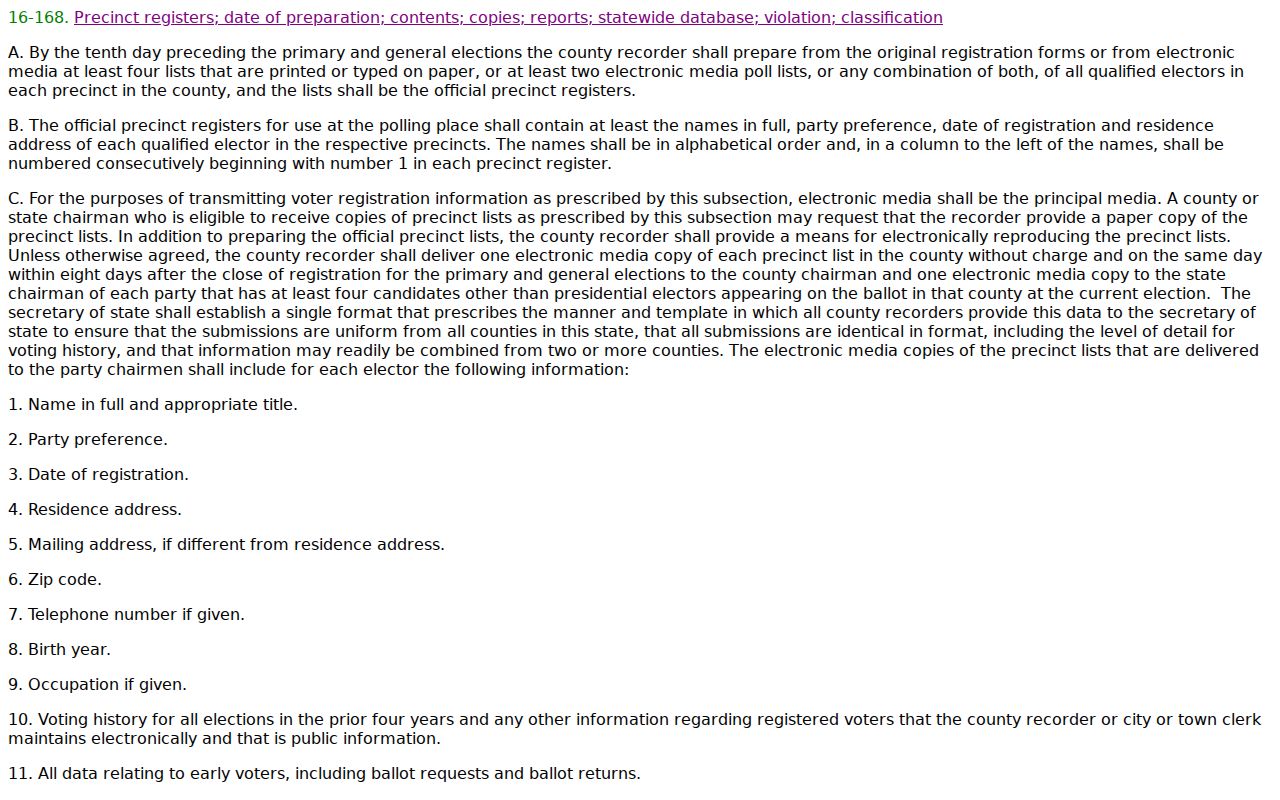
The statute capture explains why voter information cannot be repackaged as a public Florence neighbors roster.
Florence Neighbors Community Groups
Town planning materials verify four private community providers: Anthem Parkside at Merrill Ranch, Sun City Anthem at Merrill Ranch, Florence Gardens HOA, and Caliente Property Owners Association. Their facilities and resident services may help a member reach the right community contact. No authoritative public member directory was found for any of them, and the town does not publish an umbrella association roster.
| Community | Verified Public Fact | Directory Limit |
|---|---|---|
| Anthem Parkside at Merrill Ranch | Named private community provider in town material | No public household roster verified |
| Sun City Anthem at Merrill Ranch | Named private community provider in town material | Resident facilities do not establish public access |
| Florence Gardens HOA | Named association serving its community | Membership contacts are not a public resident roll |
| Caliente Property Owners Association | Named property-owner organization | Ownership group does not prove occupancy |
Florence Police supports Neighborhood Watch, but no participant roster is public. That is appropriate. A coordinator or agency contact can distribute a message without handing out private names. Churches, lodges, alumni groups, and other civic groups may also enable consent-based contact, yet the research found no verified public current-member list for Florence.
Official rolls and commercial neighbor tools should not be treated as equals. The comparison is narrow and practical.
| Source Type | Strength | Main Risk |
|---|---|---|
| Official parcel or town record | Named custodian, defined fields, correction path | Shows only the record subject, often an owner or applicant |
| Voluntary community source | Consent-based contact within a group | Access may be limited to members |
| Commercial compilation | May combine many old sources | Stale addresses, merged names, unclear correction trail |
Florence Neighbors Mapped Town Context
Town files can explain what is happening around a parcel without identifying every person nearby. Florence Fix It maps City Code Violations and routes files through Police Records. A point can indicate an issue or request at a location, but it is not proof that a named person lives there. Releasable details may require a records request and privacy review.
Open Florence Fix It before viewing the official mapped-service capture.
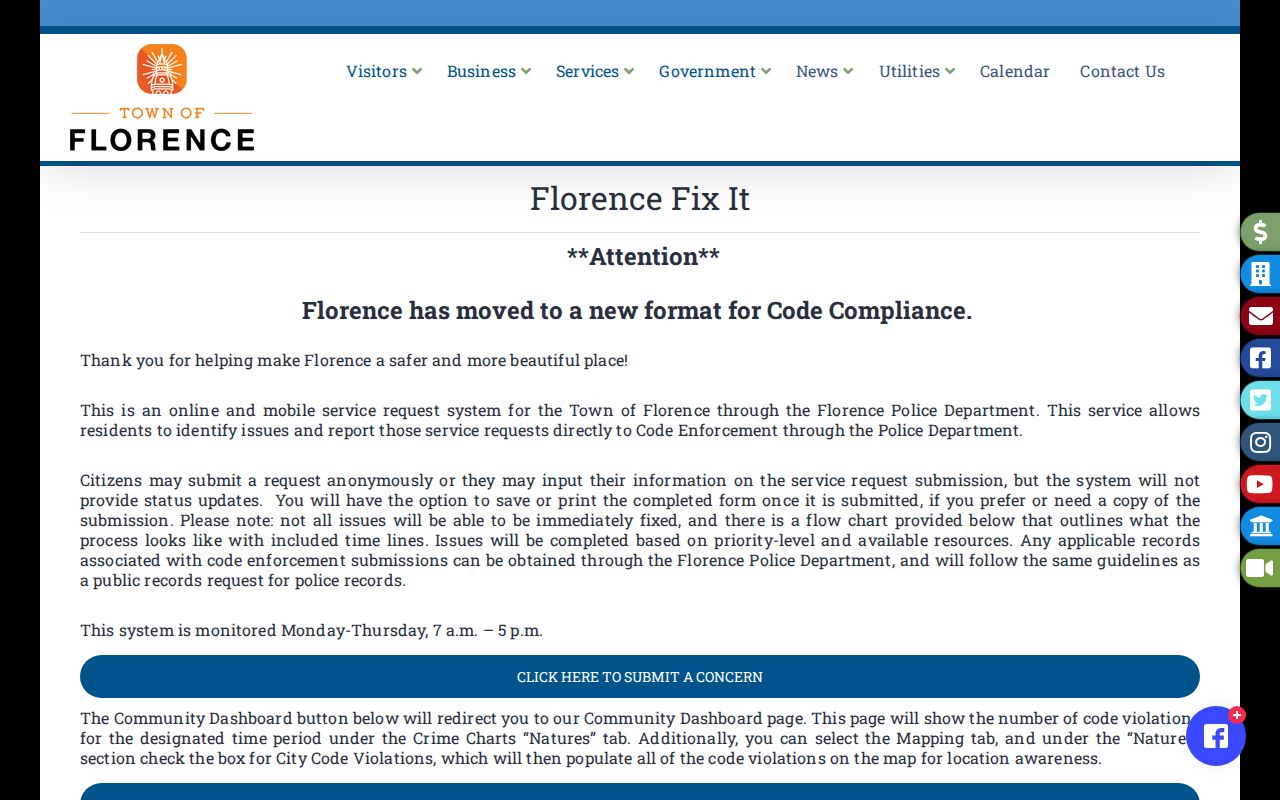
The map capture supplies civic context for the block while leaving household identity to properly scoped records.
The Florence business license list is another address-keyed source. It can show a doing-business-as name, business address, city, state, ZIP, phone, and email. It is a business contact register. A listed proprietor, employee, agent, or business address should not be converted into a claim about Florence neighbors.
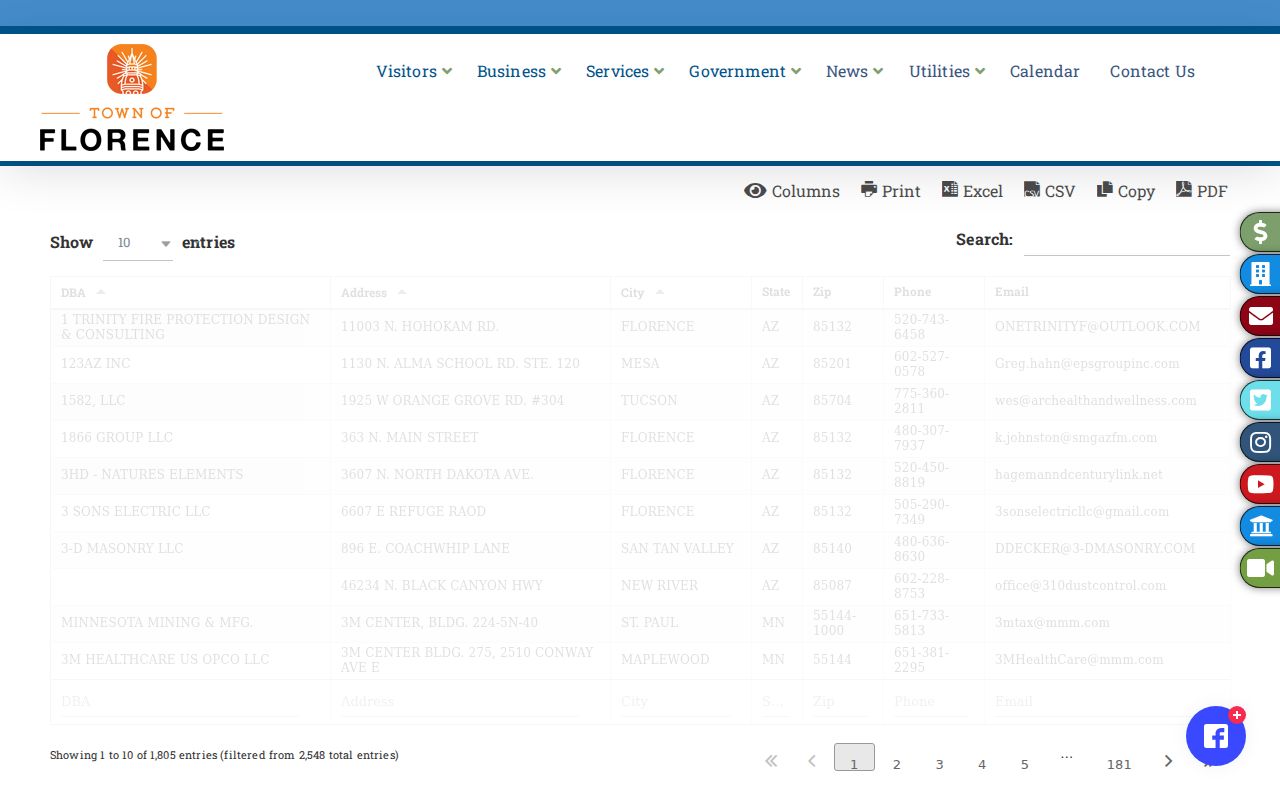
The captured register helps identify nearby public-facing firms and keeps that evidence separate from residential occupancy.
Florence Neighbor Safety Records
Safety records must be used through their own official channels and with their stated limits. The Arizona Department of Public Safety publishes sex-offender compliance resources and qualifying public information. A registry entry should be read exactly as shown, verified with the responsible agency, and never used to threaten or harass anyone. It is not a broad directory of people on a Florence block.
Review Arizona DPS sex-offender compliance resources before viewing the official program capture.
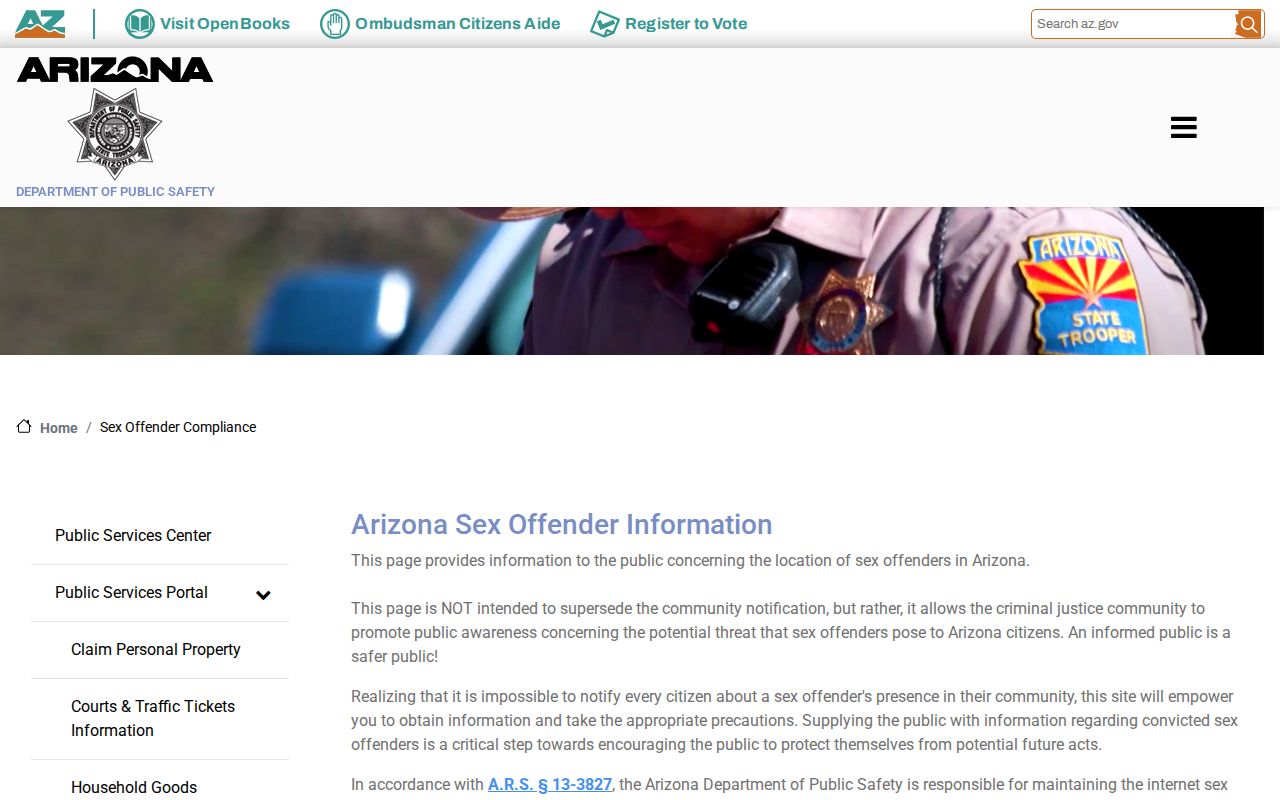
The state capture keeps the safety search within the official program and its anti-harassment rules.
For a releasable local incident or crash report, Florence Police accepts requests online, in person, and through its Records Department or fax-start channel. Delivery may be by email, mail, or pickup, and some files require a court order. This is a request for a named record, not a tool to gather open-ended facts about nearby households.
Privacy for Florence Neighbors
Renters, family members, guests, utility customers, delivery recipients, and watch participants are not exposed by the public parcel roll. Protected owners can use state procedures to shield locating information in county records. Arizona's Address Confidentiality Program supplies qualifying victims with a substitute address and mail forwarding, while protected-voter rules can seal registration records.
The lawful fallback is a precise records request, not a search for a hidden roster. The Florence Town Clerk accepts municipal requests online, through a form, and at the Town Hall counter. State public-records law requires inspection during office hours, but privacy and statutory redactions still control. Ask for a defined permit, council record, mapped case, or date range tied to an address.
Lawful use. Research about Florence neighbors is for civic awareness, consent-based contact, and personal safety. Never use property, voter, code, or registry facts to watch, harass, threaten, or intimidate anyone.
A clean block record keeps uncertainty visible. Label an assessor name as owner, a business-list name as a business contact, and an association as a private community source. If occupancy is not confirmed, say so.