
Florence Directory Collections by Year
Florence has one fully verified, digitized household directory and several strong companion sources. The Mullin-Kille Casa Grande, Coolidge, Florence and area Consurvey City Directory is the core source. Its Florence listings can be searched as names or read by street. Broader Arizona directory holdings require more staff help because no official online catalog identifies every Florence volume.
| Collection | Years | Where Held | Access |
|---|---|---|---|
| Mullin-Kille area city directory | 1960 | Arizona Memory Project | Free digitized PDF and OCR |
| Arizona State Business Directory | 1926 Florence content | Arizona Memory Project | Free digital collection |
| Arizona Educational Directory | 1954 | Arizona Memory Project | Free digital collection |
| Arizona directories and genealogy | Florence runs not itemized | State Research Library | Appointment and staff research |
| Florence and Gila River valley history | Varied | Pinal County Historical Museum | Special-collection inquiry |
The published record has gaps. The verified sources do not state Florence's first directory year, last print year, or a complete reverse-directory run. That silence calls for a reference request, not an assumed date. FamilySearch digitized the 1960 volume in 2019, and its catalog call number is 917.91DC C334 1960.
The table also separates full household sources from companions. The 1926 business volume focuses on commerce. The 1954 school volume focuses on education. Each can place a named adult in a Florence setting, but neither should be read as a list of all people then present. Keep the collection title beside every note so a later reader can see what the source was built to record.
Inside Florence's 1960 Directory
The 1960 Mullin-Kille city directory records all persons over eighteen. A spouse appears in parentheses, and a number after the couple counts dependents under eighteen. The entry can also give a phone, occupation, place of work, and home address. Those compact lines make the volume more than a phone book. It is a household snapshot with its own guide to who lived together and who owned the listed home.
The book supports two routes. The alphabetical section turns a name into an address. The householders section arranges addresses along each street, inserts cross streets, and lists the household tied to each numbered place. A researcher can therefore move from person to place or from place to nearby households without forcing a modern parcel search onto a past address.
Start with the Arizona Memory Project browser when OCR misses a spelling. Browse the scanned pages around the expected surname, then inspect the street section. OCR is a finding aid, while the page image is the source to transcribe.
Note: The verified 1960 city directory covers the wider Casa Grande, Coolidge, Florence area, so confirm that each entry belongs to Florence.
Decode a Florence Directory Entry
Every mark matters. Mullin-Kille supplies a symbol key within the book, and that key should be read before drawing a family conclusion. A bare name can hide the difference between the householder, another adult resident, and a spouse named in parentheses.
| Name | Adult resident; a wife may appear in parentheses after the listed person. |
|---|---|
| Dependent count | The following number counts dependents under eighteen. |
| ® symbol | The listed household owns the home; omission means renter in this volume. |
| h or r | h marks the householder; r marks another resident. |
| Widow form | A phrase such as “wid Robt R” identifies the deceased spouse. |
| Work and contact | Occupation or employer, residence, and telephone may follow. |
A model name entry resembles “Smith Robt R (Mary L) 3 ®.” A model street line shortens the same household to “210 Main Smith RR®.” The models show why punctuation and symbols should be copied exactly before searching other records.
- Criss-cross directory
- A directory arranged by street and house number rather than only by surname.
- Householders section
- The street-ordered part of this volume, including cross streets and listed homes.
- Abbreviation key
- The publisher's guide to marks and shortened words used in each entry.
- OCR
- Computer-read text from a scan; useful for searching but prone to name errors.
Bridge Florence's Missing Directory Years
No verified annual city directory run fills the years around 1960. The Arizona Memory Project supplies a useful bridge through the 1954 Arizona Educational Directory. Its Florence entries identify school board members, administrators, teachers, assignments, addresses, and post office boxes. The 1926 Arizona State Business Directory adds an earlier business layer. Neither source is a full household roll, yet each can connect a name with Florence in a dated record.
| Year | Florence research milestone |
|---|---|
| 1926 | Verified Florence content in the Arizona State Business Directory |
| 1950 | Latest public federal census used as a household bridge |
| 1954 | Educational directory lists Florence school personnel and contacts |
| 1960 | Mullin-Kille volume supplies name and street-order listings |
| 2019 | FamilySearch digitization milestone for the 1960 volume |
Post office boxes and general-delivery entries must stay in context. They show how mail reached a person, not where that person slept. This distinction is especially important in Florence, where the education directory often uses postal contact in place of a street address. Search a teacher or board member in 1954, compare the name with the 1950 census, and then test for an adult listing in 1960.
Camp Florence Beyond City Directories
The Sand Storm preserves names from the World War II Florence Internment Camp. The camp once held up to 6,000 German and Italian prisoners of war, while the publication captures staff and a temporary community that may not fit ordinary household sources. Most physical traces disappeared, but the paper remains searchable through Arizona Memory Project collections.
This source answers a different question from a Florence city directory. A camp staff name may signal a wartime role without establishing a long-term town home. Pair it with the 1950 census, later directories, or a newspaper notice before linking the person to a local household. The contrast also explains why a missing city-directory entry does not prove absence from Florence history.
Other local publications broaden the same era. Digitized Florence Tribune material and a history of First Presbyterian Church can identify events, groups, and family ties. They are narrative sources rather than complete rolls. Record the issue or page, then test each name against a dated household source.
Ask Florence's Historical Research Desks
Undigitized material begins with a precise question. Viney Jones Library at 778 N Main offers catalog and reference help at 520-868-8311. Hours are Monday through Wednesday 10 a.m. to 6 p.m., Thursday 10 a.m. to 8 p.m., Friday 10 a.m. to 5 p.m., and Saturday 9 a.m. to 3 p.m. Its public pages do not list exact directory, yearbook, newspaper microfilm, or obituary-index runs.
The Pinal County Historical Museum special collection, 715 S Main, focuses on Florence and the Gila River valley. Call 520-868-4382 with a name, date span, address, and source already checked. The State Research Library's Arizona Collection offers broader directory and genealogy research by appointment on weekdays, from 8:30 a.m. to noon and 1 to 4:30 p.m.
- Give every known spelling of the surname.
- Name the likely Florence street or post office box.
- State the smallest useful range of years.
- Ask whether a source is indexed, scanned, or shelf-only.
- Request a citation or page image when rules permit.
A staff reply can confirm that no cataloged volume exists or point to a local publication missed by a web search. Both outcomes prevent wasted work.
Ask staff about access before traveling. The State Research Library uses appointment periods, while a special collection may have handling rules for fragile items. If copying is limited, transcribe the title page, publisher, year, page number, and the exact line. A complete citation makes it possible to separate two people with the same name later.
Florence Burial Records Add Lives
Butte View Cemetery research shows how a thin directory clue can grow into a fuller life story. Local restoration material joins a burial with the 1886 Pinal Great Register, occupation, citizenship, and Masonic ties. The method is stronger than treating a headstone or name list as a complete identity.
Florence Memorial Park offers another closing source. Town records report 12,480 spaces, including about 3,605 occupied, yet no complete official name index was found online. Field and file information can exceed the online subset. The cemetery office at 778 N Main can be reached at 520-868-7583 or 520-868-7040, and the Florence Memorial Park page carries the revised map and contact forms.
Note: A cemetery match can support death and family research, but it does not establish every address used during a person's life.
Trace Florence Families Across Records
A Florence city directory find becomes reliable when its name, date, and place survive comparison. The released federal census is the best broad companion because schedules through 1950 are public under the 72-year rule. Later evidence can come from the 1960 directory, newspapers, probate files, death records, and cemetery staff.
The National Archives census research service explains access to released schedules and their indexes.
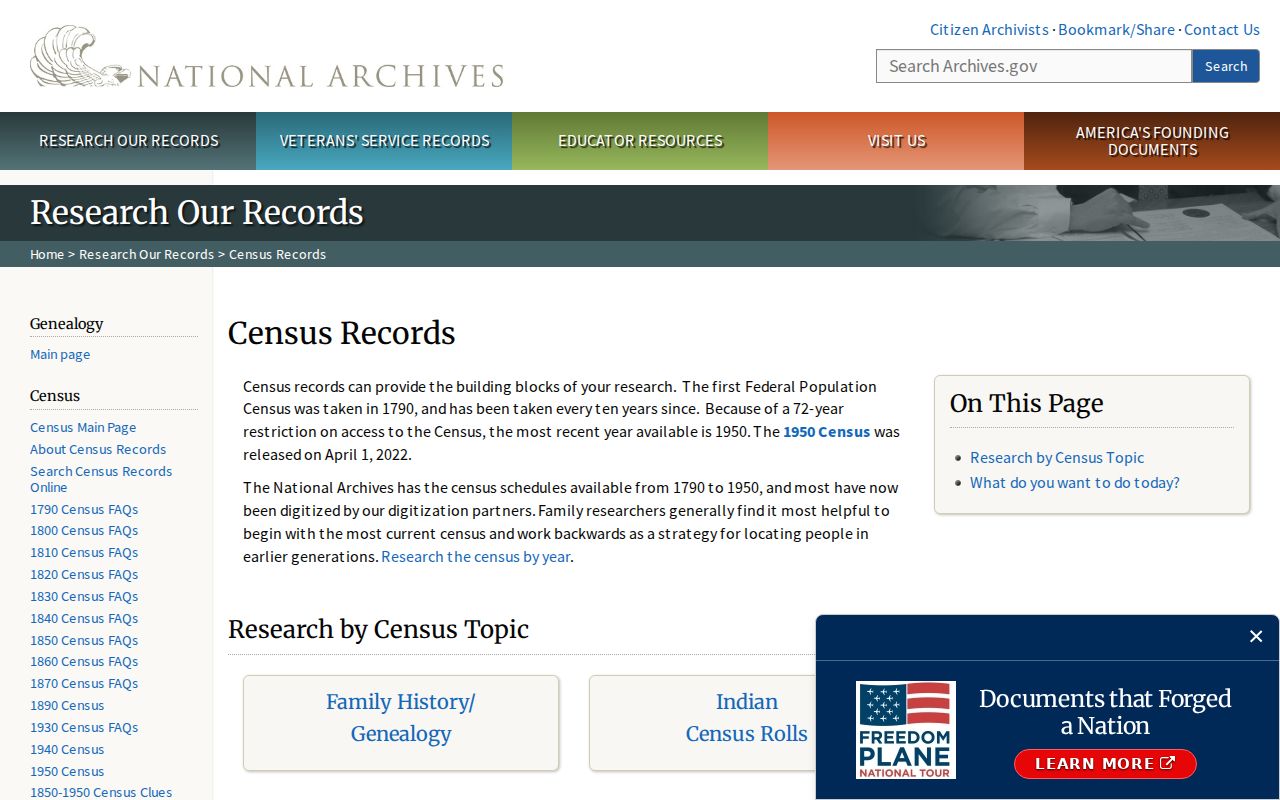
The census screen is the bridge between a dated Florence household and the federal schedule that can confirm age, kinship, birthplace, and residence in a census year.
- Search the 1960 name section and copy the full entry, including symbols.
- Turn to the street section and record nearby households and cross streets.
- Find the likely family in the 1950 census, checking age and kin ties.
- Use the 1954 school directory or newspapers to bridge the ten-year interval.
- Close the trail with probate, a death record, or cemetery files when supported.
Disappearance from a directory can mean a move, death, a missed listing, or a change in how the household was recorded. A modern address search belongs on the Florence street directory; the historical shelf should remain tied to sources from its own era.